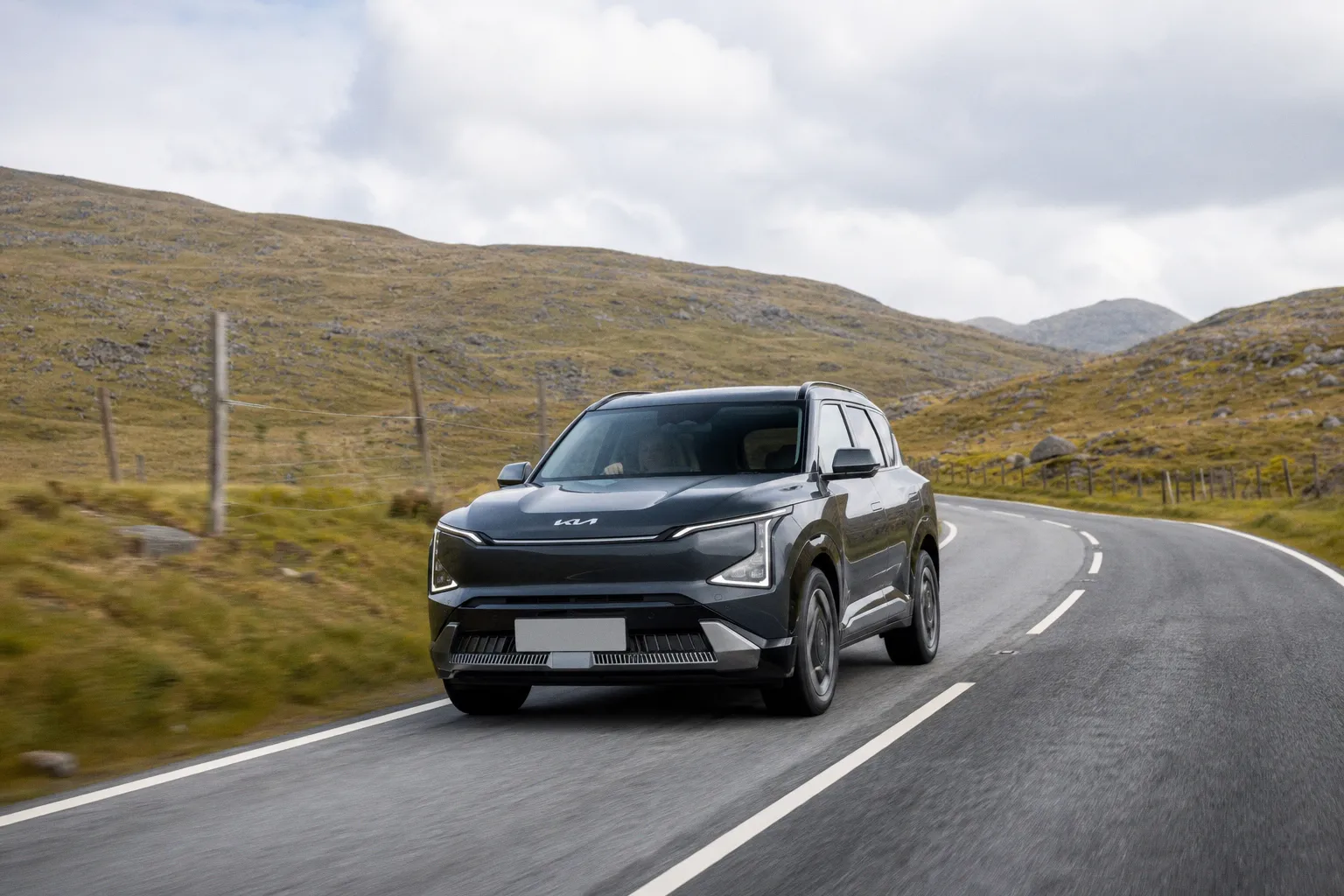
2026 Kia EV5 review: Good but is that good enough?
A week with the 2026 Kia EV5 GT-Line has produced a verdict Kia's product planners should read twice: "good but is that good enough?" EV Powered's reviewer arrived at that line after extended time behind the wheel.
Packaging metrics
The dimensional spec sheet tells most of the story. Length 4.61m. Wheelbase 2.75m. Five-seat only, where the EV9 runs seven. That wheelbase-to-length ratio is where an EV platform earns its keep — long overhangs eat the space the battery creates. Rear legroom and headroom rate as generous. The GT-Line adds a dedicated rear climate zone and heated outer seats. The middle seat has been deliberately narrowed so the outer two gain shoulder room. Four travelers fit comfortably. Five is a stretch.
Cargo runs to 566 litres with a two-level floor, plus a 44-litre frunk for cables and charge hardware. A slide-out rear tray lives in the centre console, the door pockets are deep, and the lower dashboard carries the expected curry hook. Practical storage is a clear win.
Where the powertrain data is missing
Here's the gap a battery-and-charging analyst flags immediately. The source review covers design, interior and family positioning. It does not publish a verified kWh figure, a DC peak rate, or an instrumented efficiency or range number. Those metrics are exactly what decides whether "good" translates to ownership value in this crowded mid-size segment. Until they're tested under a known standard — WLTP or EPA — the EV5's standing against the EV3, the EV9, and the wave of Chinese mid-size rivals rests on packaging and build alone. That's not nothing, but it isn't the full picture either.
Interface and build verdict
Build quality is "impeccable across every surface and touchpoint." Trim runs grey and black, which the reviewer reads as drab but durable — a Toyota-style durability signal rather than a premium-soft-touch one. The 12.3-inch screen stays in an information-and-entertainment role instead of swallowing every control, and physical buttons survive on the dash and wheel for frequently used functions. The haptic shortcut row beneath the display is the one interface snag. The buttons are slow to register and easy to trigger accidentally when a wrist rests on the dash while using the touchscreen. A software patch could clean this up; a hardware revision would be more reliable.
Buyer-side read
The EV5 reads like a scaled-down EV9 from 20 paces — same bluff front, slimline LEDs, black arch cladding, same upward tick in the rear glass. Inside, the space utilization is sound, the storage is family-grade, and the build signal is strong. What it isn't, on this evidence, is a segment-defining value play. For shoppers locked into Kia service networks or drawn to the brand's warranty terms, the EV5 is a safe purchase. For buyers optimizing on charge speed, kWh-per-km efficiency, or price per usable kilowatt-hour, the move is to wait for instrumented test data before signing.