Compare EV charging stations cost for garage vs driveway
EV Charging Stations Cost: Garage vs. Driveway Analysis
The charger unit is the cheapest part of the job. Installation labor and site-specific infrastructure are where garage and driveway budgets diverge.
The Hidden Variables of Installation Labor and Permitting
Labor accounts for 50–70% of most Level 2 home charging projects. That's the line item the industry buries in fine print, and it's the one that flips the garage-versus-driveway math.
A standard indoor wall-mount in a garage takes an electrician four to six hours. The panel is usually adjacent. Conduit runs are short, dry, and protected. No saw cutting concrete. No excavating. No submetering for outdoor loads.
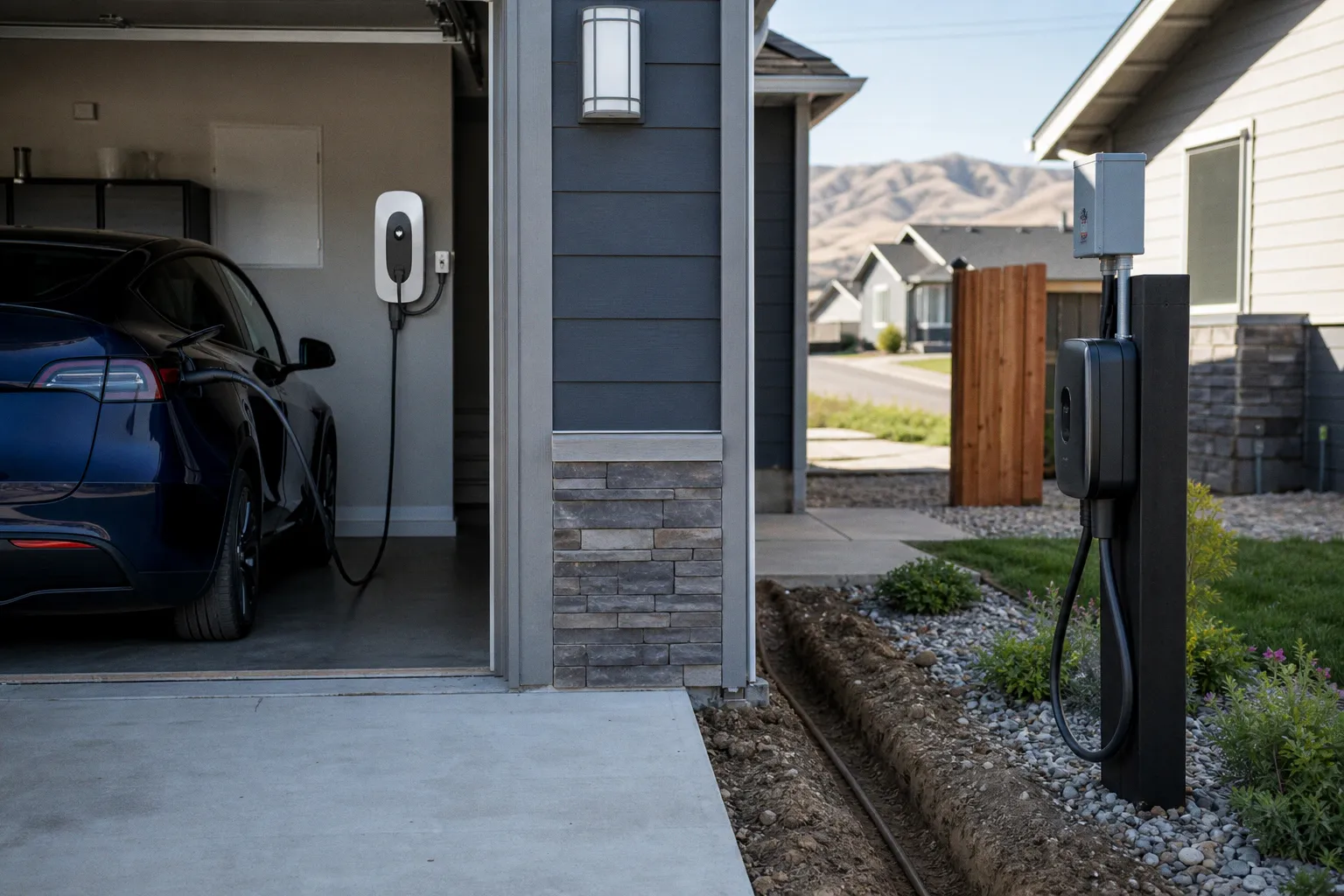
A driveway install extends the same circuit into an environment that fights back: UV degradation on PVC conduit, moisture ingress at every junction box, and—depending on the jurisdiction—mandated bollards or pedestal bases. Labor hours can climb to eight or twelve. At a typical rate of $50–$100 per hour per electrician, the labor delta alone becomes $200–$600.
Permitting adds a flat layer on top of either path. Most municipalities charge $50–$200 for an EVSE permit. Garage installations frequently get routed through existing electrical permits faster, since the inspection load is lighter. Driveway projects often trigger additional review for outdoor-rated disconnects and weatherproof conduit ratings—NEMA 3R minimum, NEMA 4 for exposed coastal or high-precipitation zones.
| Cost Component | Garage Install | Driveway Install |
|---|---|---|
| Base hardware (Level 2 EVSE) | $300–$800 | $300–$800 |
| Outdoor-rated enclosure upgrade | N/A | +$100–$300 |
| Labor (4–12 hours) | $400–$1,200 | $600–$1,700 |
| Permit fees | $50–$200 | $50–$200 |
| Trenching (if required) | $0–$200 | $200–$2,000+ |
| Total range | $750–$2,400 | $1,250–$5,000+ |
The spread isn't theoretical. It's measured on real invoices from Fixr, HomeAdvisor, and Forbes Home 2026 install surveys.
Why Driveway Setups Demand Premium Weatherproof Hardware
The hardware delta isn't cosmetic. Driveway chargers must meet ingress protection standards that garage units skip entirely. An indoor-rated EVSE carries a NEMA 1 or NEMA 2 rating — sufficient for dry wall-mount environments with minimal dust exposure. Rain, snow, splashing from tires, and temperature swings across 80°C annual deltas require something harder.
NEMA 3R enclosures protect against falling rain and sleet. NEMA 4 adds protection against hose-directed water and ice formation. Both ratings add $100–$300 to the unit cost versus a comparable indoor model with identical peak charge rates.
There's a thermal consideration that doesn't show up on spec sheets. Outdoor units in direct sun operate at higher ambient temperatures. Internal components derate sooner — meaning the charger may pull full 40A output at 25°C but throttle to 32A at 45°C ambient. This thermal throttling effect is documented in SAE J1772 testing and varies by manufacturer. Garage-mounted units rarely hit the temperature ceiling.
NEMA 3R is the baseline for outdoor use. Anything less voids manufacturer warranties in moisture-prone climates.
For homeowners in coastal regions (saline air) or freeze-thaw zones, NEMA 4X stainless enclosures become mandatory. The premium extends to $400+ over an indoor equivalent. It's not optional — it's the difference between a charger that lasts eight years and one that fails at year three.
Calculating the Financial Impact of Trenching and Conduit Runs
Trenching is the largest single variable between a $750 install and a $5,000 install. At $10–$50 per linear foot, the math compounds fast.
A garage on an exterior wall with a panel within 10 feet requires zero trenching. Conduit runs through stud cavities or surface-mounted EMT (electrical metallic tubing). Total conduit cost: $30–$80.
A driveway 30 feet from the house requires 30+ linear feet of trenching plus rigid PVC or EMT conduit rated for direct burial. At a midpoint of $25/foot, that's $750 of trenching alone — before the electrician bills for digging time. If the run crosses a walkway or driveway apron, concrete cutting adds $200–$500.
The total trenching plus conduit cost curve looks like this:
| Distance from Panel | Trenching + Conduit Cost |
|---|---|
| 0–10 ft (garage, adjacent) | $0–$150 |
| 10–25 ft (short run) | $250–$750 |
| 25–50 ft (extended run) | $750–$1,800 |
| 50+ ft (across property) | $1,500–$3,000+ |
The break-even point sits around 15 feet. Below that, both install types converge. Above it, driveways lose their cost advantage unless the panel is already mounted on an adjacent exterior wall.
Strategic Panel Placement: Minimizing Costs in Indoor vs. Outdoor Projects
Panel proximity is the single biggest cost lever. It outranks weatherproofing, permits, and even the charger brand.
A garage with a 200A panel on the same wall as the charger mount is the optimal case. The circuit runs in EMT through existing stud bays. No trenching. No weatherproofing premium. No long conduit. Cost: $400–$800 total.
A driveway adjacent to a side wall with the panel? Often cheaper than a detached garage on the opposite side of the house. The 10–15-foot surface-mounted conduit run with weatherproof junction boxes avoids trenching entirely. Cost: $750–$1,400.
A detached garage 50+ feet from the main panel? Most expensive. The cost drivers stack: long trench run, sub-panel sizing, separate grounding electrode, dedicated conduit diameter. Expect $2,500–$5,000.
The 2026 install data from Angi confirms this: projects where the charger sits within 15 linear feet of the panel — regardless of indoor or outdoor location — average 30–40% lower than runs exceeding 30 feet.
Panel location determines 60% of total install cost. Charger placement is secondary.
Some homeowners retrofit a sub-panel near the parking space to shorten the run. A 100A sub-panel runs $500–$1,500 installed, and often pays back through reduced trenching and conduit costs when the alternative exceeds 40 linear feet.
Navigating Municipal Fees and Compliance Requirements
Permit fees are the smallest line item but carry the highest compliance risk. Most jurisdictions require:
- Electrical permit: $50–$200
- Inspection scheduling: 1–3 weeks lead time (varies by municipality)
- NEC 625 compliance verification (the EV charging standard)
- Load calculation worksheet showing the additional draw on the existing service
Driveway installations often trigger extra reviews for:
- Outdoor disconnect placement (typically within sight of the charger)
- Bollard or wheel-stop protection in commercial zones (rare at residential, but exists in some HOA jurisdictions)
- Grounding electrode verification at the sub-panel site
Skipping the permit is the most common mistake. Cities like Los Angeles, Austin, and Seattle have ramped up unpermitted-work enforcement through 2025–2026. Fines range from $500 to $5,000. Insurance claims for electrical fires at unpermitted EVSE installations routinely deny coverage.
For homeowners bundling an EV charger install with other electrical work — service panel upgrades, solar interconnects, or smart home electrical work — permit packages often consolidate fees, reducing per-project overhead. It's worth timing the EV charger install with other panel work to leverage this.
The Verdict: What Garage Owners Actually Pay vs. Driveway Owners
The cost difference between garage and driveway installations is real but conditional. In the median case, a garage install lands at $1,000–$1,500 total. A comparable driveway install lands at $1,600–$2,500 total. The delta of $600–$1,000 is the weatherproof hardware premium, longer labor hours, and typically some trenching.
Three exceptions flip the math:
1. Panel on exterior wall adjacent to driveway. Install drops to $1,000–$1,300 — cheaper than many garage retrofits.
2. Long garage-to-panel run (40+ feet). Garage costs climb to $2,000+. Driveway with a short run stays cheaper.
3. Existing outdoor-rated sub-panel at driveway location. Eliminates the trenching cost entirely.
The cheapest install path: a charger within 15 feet of the panel, in any protected environment. The most expensive: a driveway 50+ feet from the main service with full trenching required.
For homeowners planning a charger install in 2026, the analysis isn't "garage or driveway." It's "where is my electrical panel, how far is it from my parking spot, and what's the weather exposure." Those three variables control 80% of the budget. Everything else — charger brand, smart features, WiFi connectivity — is incremental and can be budgeted separately.
If you're also evaluating smart home upgrades alongside the EV charger project, the Prime Day 2026 smart home deals cycle hits at the right time for bundled appliance and automation purchases, though charger hardware itself rarely sees Prime Day discounts.
Garage or driveway, the cost discipline is the same: get quotes that itemize hardware, labor, trenching, and permits separately. Total them against the panel-distance math above. The real cost of a home charging station isn't in the charger — it's in the wire run between the panel and the parking space.