Compare EV Lease vs Buy Options for the $7,500 Credit
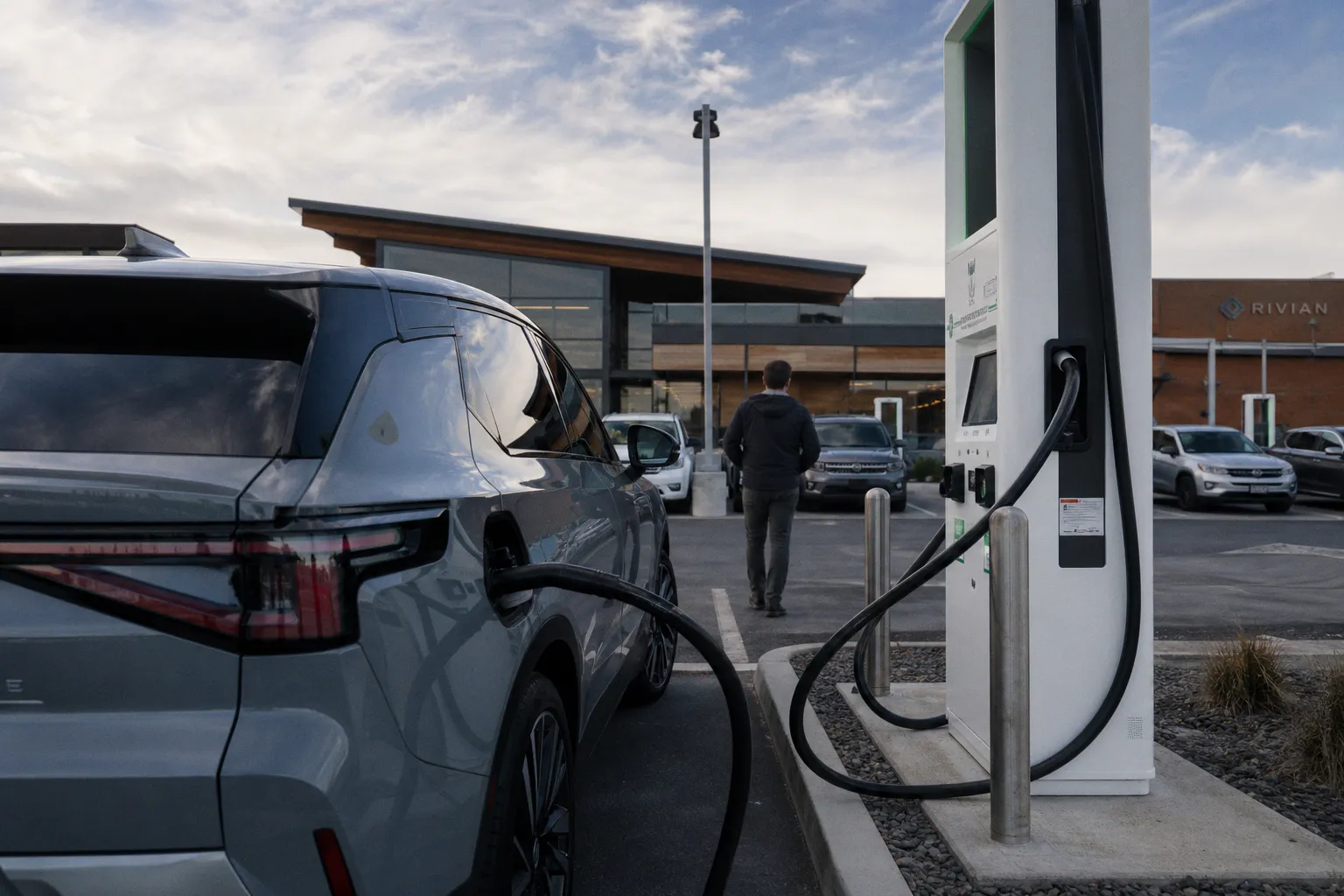
For buyers above the MAGI threshold, for shoppers eyeing sedans priced above $55,000, or for anyone considering a vehicle that fails the battery component test, the purchase path is closed. The lease path often remains open. Understanding the gap between these two paths is the difference between claiming $7,500 and missing it entirely.
The Commercial Vehicle Loophole: How Leasing Bypasses Strict Eligibility
When a manufacturer or finance company leases a passenger EV to a consumer, the IRS treats that transaction as a sale to a commercial fleet operator for tax purposes. Section 45W of the Internal Revenue Code applies. That section has no MSRP cap. It has no buyer income limit. It has no North American final assembly requirement. It has no battery component or critical mineral sourcing test.
The vehicle moves through lease channels and the sourcing rules from Section 30D do not transfer with it. A $92,000 luxury sedan assembled in Germany with a Chinese-built battery pack can still generate the full $7,500 credit when leased. The same car purchased outright generates zero.
This is not a quirk or an accident. The Inflation Reduction Act, enacted August 16, 2022, rewrote both sections simultaneously. The effective date for the updated framework landed January 1, 2023. Congress wrote the lease exemption deliberately to keep incentive money flowing into EV adoption regardless of where the battery was built or what the buyer's tax return looks like.
Section 45W operates without the price ceiling, the income gate, and the battery sourcing test that Section 30D imposes on retail buyers.
The mechanical effect: the finance company claims the $7,500 directly on their corporate return. They keep it, discount it into the lease, or split the difference. The consumer never files IRS Form 8936 for a leased vehicle. The transaction lives entirely on the lease contract as a capitalized cost adjustment, with no tax filing required from the lessee.
Decoding the Section 30D Purchase Requirements: MSRP and Income Caps
The purchase path is far narrower. To claim the full $7,500 under Section 30D, four conditions must clear simultaneously.
Final assembly. The vehicle must undergo final assembly in North America. The U.S. Department of Energy maintains the eligible list, updated regularly as manufacturers submit documentation. Vehicles assembled outside the U.S., Canada, or Mexico are excluded entirely. Many popular European and Asian EVs fall into this exclusion category regardless of price or buyer income.
MSRP ceiling. The cap is $80,000 for vans, SUVs, and pickup trucks. The cap drops to $55,000 for all other body styles, including sedans, hatchbacks, and coupes. A $62,000 sedan assembled in North America still fails. A $78,000 SUV with the same assembly origin passes.
Buyer income. Modified Adjusted Gross Income limits apply. The thresholds are $300,000 for joint filers, $225,000 for heads of household, and $150,000 for single filers and married filing separately. The test uses the lesser of the current year or prior year MAGI. A household earning $310,000 loses the credit on any purchase. The same household can lease any EV and receive the incentive through the lessor.
Battery sourcing. A percentage of the battery's critical minerals must be extracted or processed in the U.S. or a free trade agreement partner country. A percentage of battery components must be manufactured or assembled in North America. These percentages step up annually through 2030. A vehicle qualifying in 2024 may fail in 2026 if the supply chain does not rebalance.
Vehicles meeting all four conditions get the full $7,500. Vehicles clearing the mineral test but failing the component test receive $3,750. Vehicles clearing the component test but failing the mineral test receive $3,750. Vehicles clearing neither receive zero. The credit is also non-refundable — a buyer with $4,000 in federal tax liability cannot recover the remaining $3,500 as a refund.
| Parameter | Lease Path (Section 45W) | Purchase Path (Section 30D) |
|---|---|---|
| Maximum Credit | $7,500 (claimed by lessor) | $7,500 (claimed by buyer) |
| MSRP Cap | None | $80,000 SUV/Van/Pickup / $55,000 Sedan |
| Buyer MAGI Limit | None | $300,000 joint / $225,000 HoH / $150,000 single |
| North American Assembly | Not required | Required |
| Battery Sourcing Test | Not required | Required, escalating annually |
| Credit Delivery | Capitalized cost reduction on lease | IRS Form 8936, applied at tax filing |
| Tax Filing Required from Consumer | No | Yes |
The Reality of Lease Incentives: Why the Credit Isn't Always Guaranteed
The $7,500 exists on every lease-eligible EV in theory. In practice, the pass-through to the lessee depends on the manufacturer's finance arm and current market conditions.
The mechanic: the lessor — typically a captive finance company, a major bank, or a third-party leasing entity — takes the credit on their tax return. They then apply it to the lease. Standard application is a capitalized cost reduction. The $7,500 drops the gross capitalized cost by that amount, which lowers the monthly payment across the lease term. A 36-month lease on a vehicle with $0 down and a 0.00120 money factor translates roughly $208 per month of credit into real monthly savings, before interest.
Some manufacturers pass the full amount on every lease. Others pass partial credit, especially on high-demand vehicles where lease volume is already strong and the finance company has pricing leverage. A few apply the credit on a per-vehicle basis at the dealership level rather than across the entire lease contract, which can produce uneven results depending on trim, options, and dealer inventory age.
The variable: the lessor has no contractual obligation to pass any specific dollar amount. Section 45W grants them the credit. How they deploy it is a marketing, inventory, and pricing decision. Shoppers must verify the effective lease payment reflects the credit. A dealer quoting a lease rate at MSRP with no mention of a $7,500 reduction is a flag, not a baseline. The advertised monthly payment and the negotiated monthly payment must be compared line by line against the unadjusted base capitalized cost.
The lease credit is the lessor's to allocate. Consumer verification beats assumption.
There is one further structural point. The credit cannot be claimed retroactively by the consumer. A lessee who signs a lease believing the credit will arrive at signing and finds instead that the dealer applied only $4,000 has limited recourse. The $7,500 is taken at the corporate level by the lessor. The discount to the consumer is a separate contract term negotiated at signing.
Strategic Financial Planning: When Leasing Outperforms Direct Ownership
The math turns sharply in favor of leasing under three specific conditions.
Income above MAGI cap. A household at $325,000 joint cannot claim the credit on purchase. They can lease a $90,000 EV and the manufacturer's finance arm can pass $7,500 through. The purchase alternative delivers zero on the credit line, while the lease alternative puts real dollars against the capitalized cost. Even if only $5,000 of the $7,500 reaches the lessee, the lease still wins on credit capture.
Vehicle MSRP exceeds sedan cap. A $58,000 sedan assembled in North America fails the $55,000 sedan test. The same vehicle on a 3-year lease with credit pass-through costs less over the equivalent holding period than the depreciated purchase price. The lease is the only mechanism that converts an ineligible MSRP into a credit-eligible transaction.
Battery sourcing disqualifies direct purchase. A buyer who wants a specific EV that fails the critical mineral test has no purchase incentive path. The lease channel remains open regardless of battery origin, and Section 45W never imposes a sourcing test.
The case against leasing is straightforward when none of those conditions apply. A buyer under the MAGI cap buying a $50,000 SUV that meets all sourcing requirements can claim $7,500 directly. They also build equity. They avoid mileage caps (typically 10,000–15,000 miles per year) and the excess mileage penalty (often $0.25 per mile). They avoid disposition fees and excess wear charges at lease end. Over a 5–7 year hold, purchase usually wins on total cost of ownership by 15–25%.
The hybrid path also exists. Lease for 3 years. Use the pass-through credit. Buy out the residual at lease end with cash or outside financing. The residual was set at lease signing based on projected depreciation. If the vehicle holds value better than projected, the buyout price is favorable. If not, walk away and lease the next model. The downside is mileage accumulation and wear during the initial lease term, both of which reduce the practical buyout math.
Modern ownership tooling has reshaped how shoppers run these comparisons. Telemetry from the EV, mobile-based lease management apps, and real-time residual estimators let consumers model both paths in minutes. The decision often comes down to which regulator-approved channel produces the lower total outflow over the holding period — and that channel requires reliable cost data across electricity rates, insurance, mobile connectivity for telematics, and ongoing service subscriptions. Buyers mapping the full ownership stack typically cross-reference electricity tariffs, insurance quotes, and charging costs against maintenance schedules to build a defensible total-cost picture.
Navigating North American Assembly and Battery Sourcing Constraints
The sourcing rules under Section 30D are the most operationally complex piece of the purchase path. Three constraints stack in sequence.
Final assembly must occur in North America. The DOE maintains a public list of qualified vehicles, updated as manufacturers submit documentation. Vehicles on the list change month to month as production lines shift and supply chains reroute. A vehicle on the list in March can drop off in May if the manufacturer changes a supply contract.
Critical mineral sourcing applies to the battery cathode and anode materials. The percentage of qualifying minerals — extracted or processed in the U.S. or an FTA partner country, or recycled in North America — must hit an annual threshold. The threshold started at 40% in 2023 and steps up to 100% by 2030. A vehicle qualifying in 2024 with 50% qualifying minerals may not qualify in 2026 if the threshold moves to 70%.
Battery component sourcing applies to components manufactured or assembled in North America. Same annual escalation schedule, starting at 50% in 2023 and rising to 100% by 2029. A battery pack assembled in Mexico with cells from Korea may pass the component test while failing the mineral test, or vice versa.
The sourcing escalator runs through 2030. A car qualifying this year may be ineligible in two.
The lease channel bypasses all of this. Section 45W requires no assembly verification, no mineral audit, no component audit. The vehicle can be built anywhere with anything inside it, and the credit still flows to the lessor. The sourcing rules apply only to consumer purchases under Section 30D.
This is the structural advantage of the lease path. It is not a marketing discount, a dealer concession, a regional rebate, or a manufacturer incentive layered on top of the federal credit. It is a federal tax code path that exists for commercial vehicles and is routinely applied to consumer leases. The loophole label is colloquial. The regulatory mechanism is precise and intentional.
The Practical Verdict
Leasing wins when the purchase path is closed. That covers buyers above MAGI limits, vehicles over the sedan MSRP cap, and any EV that fails current battery sourcing tests. The credit lands as a capitalized cost reduction on the lease contract. The pass-through is standard practice across most major manufacturers but is not contractually guaranteed — verify that the credit appears in the negotiated price, not just in the advertised headline rate.
Buying wins when the purchase path is open and the buyer plans to hold the vehicle past the lease term. Capture the credit directly on IRS Form 8936 at filing. Build equity. Avoid mileage and wear penalties. The total cost of ownership typically favors purchase by 15–25% over a 6-year hold when all four Section 30D conditions are met and the vehicle retains at least 40% of its value after the holding period.
The blend — lease, capture the credit, buy out the residual if value holds — works for shoppers who want both the credit and the option to own. The decision matrix is not complex. It is dictated entirely by which code section applies to the transaction, and that determination is mechanical: if you take title, Section 30D applies. If the lessor retains title, Section 45W applies. The shopper's job is to read the contract type, not the marketing language around it.
Related articles
 Battery & EV TechChoose the right EV battery chemistry for freezing winters
 Renault China adds software office to develop SDVs for global market
 Charging & InfrastructureBuy the Safest CCS to NACS Adapters for Non-Tesla EVs
 EV Models & ReviewsCompare highway range of three electric SUVs under $50,000