California EV Tax Credit: Which State Incentives Apply to You?
Federal new- and used-EV credits are also unavailable for vehicles acquired after September 30, 2025, except for narrow cases involving a binding contract and payment made by that cutoff.
What remains is a fragmented incentive system. The current California electric vehicle incentives are split by buyer profile: first-time ZEV ownership, household income, location, utility territory, and—in one major program—the retirement of an older vehicle. The difference between a $1,000 utility rebate and a potential $14,000 Clean Cars 4 All package is not a formality. It is determined by the transaction structure before the vehicle is purchased.
The old California EV tax credit is gone. MyFirstEV is not one.
The broad California program many buyers still remember was CVRP. It is closed. There is no active statewide California income-tax credit that operates like the former federal clean-vehicle credit.
California’s replacement headline program is MyFirstEV, announced on July 16, 2026. It is structured as an instant point-of-sale rebate, not a tax credit. That distinction matters.
A tax credit reduces tax liability after a purchase and may depend on filing status, income, tax owed, and timing. A point-of-sale rebate reduces the transaction cost at the dealer or participating seller. It affects the financed amount immediately. For a 72-month loan, reducing the principal by $3,500 also reduces the interest paid over the life of the loan. The exact reduction depends on APR, but the direction is fixed: lower financed principal produces lower interest expense.
MyFirstEV is aimed at Californians buying or leasing their first zero-emission vehicle. The announced structure is straightforward:
| Parameter | New EV | Used EV |
|---|---|---|
| Announced instant rebate | $3,500 | $1,750 |
| Vehicle price limit | MSRP up to $50,000 | Price up to $25,000 |
| Seller requirement | Participating automaker | Manufacturer-certified pre-owned program |
| Buyer profile | First-time ZEV buyer or lessee | First-time ZEV buyer or lessee |
| Program status | Announced; rollout details pending | Announced; rollout details pending |
California committed $135 million to the program. Participating automakers are expected to match the state contribution dollar-for-dollar, creating an announced $270 million consumer savings pool. The manufacturers named at launch were Ford, General Motors, Honda, Hyundai, Kia, Lucid, Mitsubishi, Nissan, Rivian, Subaru, Tesla, Toyota, and Volvo.
The hardware constraint is price. A vehicle can be battery-electric, have a useful DC fast-charge curve, and fit a buyer’s driving cycle, but it will not fit the announced MyFirstEV framework if the MSRP exceeds $50,000. The same applies to used inventory above $25,000.
There is another constraint: the used EV must be sold through a manufacturer-certified pre-owned channel. A private-party purchase does not meet that announced condition. Neither does every used car on a franchise dealer’s lot. “Certified” has to refer to the manufacturer program, not merely a dealer inspection.
MyFirstEV is a transaction rebate with pending implementation rules. Do not model it as guaranteed cash until the participating seller can apply it to the deal.
The first rebates were expected later in summer 2026, with further California Air Resources Board details expected after the announcement. That leaves several operational questions unresolved: dealer enrollment, proof of first-ZEV status, program workflow, and whether MyFirstEV can be combined with other state, local, utility, or manufacturer offers.
Do not sign a purchase agreement assuming stacking. Get the transaction worksheet in writing.
Clean Cars 4 All is the high-value route, but it is not a normal purchase rebate
Clean Cars 4 All is the program with the largest published support figures. It is also the least universal.
This is a vehicle-replacement program. The applicant must meet income limits, live in an eligible administered region, and provide a qualifying older vehicle for retirement. In practical terms, it is designed to remove older internal-combustion vehicles from service while moving income-qualified households into lower-emission transportation.
The income ceiling is household income at or below 300% of the Federal Poverty Level. Administration is listed in five major air districts:
- South Coast
- San Joaquin Valley
- Bay Area
- Sacramento
- San Diego
The published support levels are substantial:
| Clean Cars 4 All component | Published maximum |
|---|---|
| Toward an eight-year-old-or-newer ZEV | Up to $10,000 |
| ZEV support in qualifying disadvantaged communities | Up to $12,000 |
| Charging equipment or prepaid charging card | Up to $2,000 |
The maximum package can therefore reach $12,000 for the vehicle plus $2,000 for charging support in qualifying disadvantaged communities. That is not equivalent to a $14,000 discount on any EV in any part of California. Eligibility is conditional at every stage.
The vehicle being retired is central. A buyer who has already sold, traded, or scrapped the old car may have removed the asset required for the application. A buyer outside the participating air districts may meet the income threshold and still have no access to the program. A household that has previously received related incentive funding may also be excluded.
This is why Clean Cars 4 All eligibility must be checked before shopping inventory. The correct sequence is not: choose an EV, negotiate price, then hunt for grants. It is: confirm district administration, income qualification, previous-program status, and retirement-vehicle eligibility; then select the replacement vehicle within the program rules.
The charging component deserves equal attention. A household without home charging often spends more time at DC fast chargers, where energy prices are generally higher and charging sessions are constrained by peak charge rate and battery temperature. A prepaid public-charging balance can be more useful than a home EVSE for an apartment resident. For a homeowner with off-street parking, charging equipment may produce lower operating cost over several years.
The right incentive package is therefore not just the highest headline number. It is the package that fits the charging topology of the household.
Utility rebates can change the used-EV calculation
State programs get the attention. Utility incentives often decide whether a used EV is viable.
These offers are not statewide. They are tied to electricity service territory, customer account status, income qualification, purchase timing, vehicle lists, and available funding. They can be smaller than Clean Cars 4 All, but they are often more relevant to a buyer replacing a working vehicle without an eligible car to retire.
Southern California Edison provides a clean example. Eligible residential customers can receive:
- $1,000 for a qualifying pre-owned EV.
- $4,000 for income-qualified customers purchasing or leasing a qualifying pre-owned EV.
- An application window of 180 days after purchase or lease.
- A requirement to keep the vehicle California-registered to the applicant for at least 20 months.
The 180-day deadline is a hard operational limit. Do not assume a rebate can be claimed after the first registration cycle, after refinancing, or after a title transfer. Save the purchase agreement, registration documentation, VIN records, proof of utility account status, and any income-verification materials before submitting.
For a buyer evaluating a $20,000 used EV, a $1,000 utility rebate is a 5% reduction in vehicle price. A $4,000 income-qualified rebate is 20%. At that point, the program changes the effective purchase price more than a modest negotiation over dealer documentation fees.
There is a second-order effect. Utility territory also determines electricity rates, time-of-use plans, and potential charging-program enrollment. The acquisition incentive may be small, while the operating-cost difference over four years is not. An EV with a 60 kWh usable pack and a realistic 3.2 miles per kWh consumes roughly 18.75 kWh per 60 miles driven. The rate paid for those kilowatt-hours matters more than marketing claims about “fuel savings.”
A buyer should evaluate three separate numbers:
1. Vehicle acquisition support. State rebate, utility rebate, manufacturer cash, and any local program that explicitly permits the transaction.
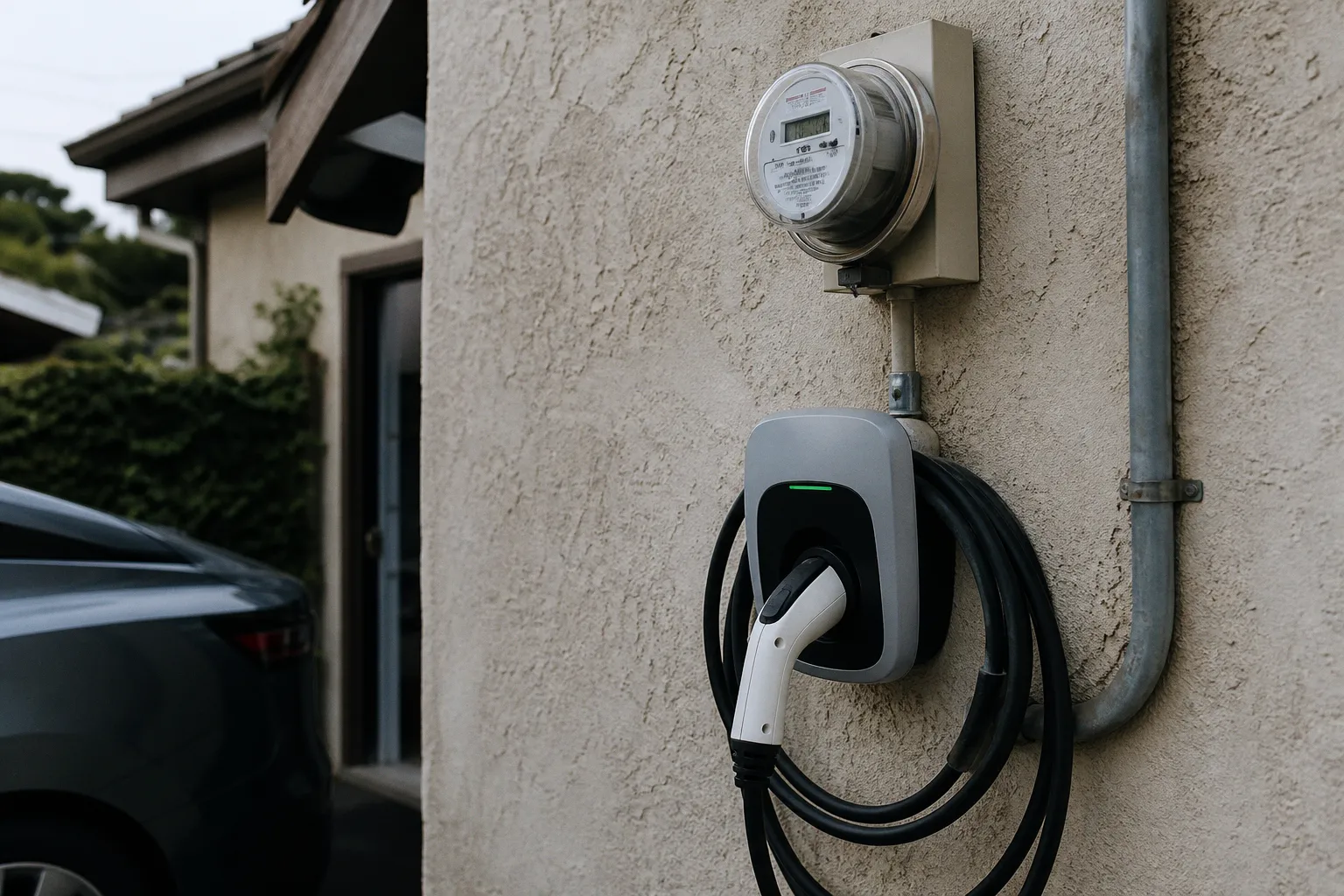
2. Charging capital cost. Panel capacity, circuit run length, EVSE hardware, permitting, and whether the home can support a Level 2 load without service upgrades.
3. Energy operating cost. Off-peak home rate, workplace charging availability, public DC fast-charging use, and expected annual mileage.
The rebate is a one-time number. Electricity pricing is recurring.
Federal credits are not part of a normal 2026 purchase model
A major source of bad advice is the assumption that buyers can still apply a federal $7,500 new-EV credit or a federal used-EV credit to a 2026 purchase. For vehicles acquired after September 30, 2025, those credits are unavailable.
There is a narrow exception for a vehicle placed in service later if the buyer had entered a binding written contract and made a payment on or before September 30, 2025. That is not a workaround for a shopper beginning the process in 2026. It is a transitional rule for an acquisition already underway by the cutoff.
This changes lease math as well. Do not assume a lease quote includes a federal pass-through incentive. Examine the capitalized cost reduction, base payment, money factor, residual value, acquisition fee, disposition fee, and mileage allowance. If the dealer claims an incentive is embedded in the lease, request the worksheet showing exactly where it appears.
The same discipline applies to software and connected-service promises. A battery warranty has measurable terms: duration, mileage, capacity-retention threshold, exclusions, and transferability. A “feature” sold through a connected platform may have different ownership terms. The wider argument over digital ownership in the video-game industry is not an EV incentive issue, but the underlying lesson transfers: define what is included in the purchase, what is licensed, and what can change after delivery.
For an EV buyer, that means distinguishing the physical vehicle from subscription functions, charging-network access, telematics services, and future software enablement. None of those items substitutes for a rebate.
In 2026, the federal EV credit should be treated as zero unless the buyer can document the pre-September 30, 2025 contract exception.
Can California EV incentives be stacked?
The honest answer is: sometimes, but not by assumption.
No published rule in the available program details establishes that MyFirstEV can be combined with Clean Cars 4 All, an SCE pre-owned EV rebate, manufacturer incentives, or local assistance. The programs have different funding sources and different objectives. That does not prove they conflict. It means the combination must be confirmed by the program terms and by the seller before delivery.
There are three common failure modes.
1. Buying before program approval
This is the most expensive error for Clean Cars 4 All applicants. The program’s vehicle-retirement structure means the old vehicle and the replacement purchase are part of one eligibility chain. Completing a trade-in or purchase before approval can break that chain.
2. Treating MSRP, sale price, and financed amount as interchangeable
They are not interchangeable.
MyFirstEV’s announced new-vehicle threshold is based on MSRP up to $50,000. A dealer discount does not necessarily make a $52,000-MSRP vehicle eligible. On the used side, the stated ceiling is a vehicle price of up to $25,000 through a manufacturer-certified pre-owned program. Taxes, registration, dealer fees, accessories, warranties, and financing products need to be separated from the vehicle price when assessing eligibility.
3. Confusing utility eligibility with statewide eligibility
An SCE customer may have access to a qualifying pre-owned-EV rebate. A PG&E, SDG&E, municipal-utility, or community-choice customer may face different terms or no equivalent program. Service address matters. A California driver’s license alone does not establish utility-program eligibility.
For buyers who can plausibly qualify for more than one source of support, the order of operations should be controlled:
1. Identify the utility serving the home address and review its active vehicle and charging offers.
2. Determine whether household income and location fit Clean Cars 4 All before disposing of the current vehicle.
3. Confirm whether the prospective vehicle is new or manufacturer-certified used, its MSRP or sale price, and its manufacturer’s participation in MyFirstEV.
4. Ask the dealer to state in writing whether the point-of-sale rebate is available on that VIN and whether it can coexist with other discounts.
5. Preserve every document. Incentive programs are administered through records, not verbal assurances.
The correct California incentive route depends on the buyer, not the badge on the car
The comparison is not between “getting a California EV tax credit” and getting nothing. That old framing is obsolete.
A first-time ZEV buyer looking at a sub-$50,000 new EV should watch MyFirstEV, but should not count the $3,500 until the program is live and the dealer can execute it. A low-income household in an eligible air district with an older vehicle to retire should evaluate Clean Cars 4 All first; its published support is materially larger, but its eligibility gate is tighter. A used-EV buyer outside that pathway should start with the serving utility, where a $1,000 or income-qualified $4,000 rebate can materially change effective cost.
The vehicle still has to work after the incentive is applied. Check battery warranty terms, usable range in the buyer’s climate, DC charging behavior after repeated sessions, tire cost, insurance premium, and home-charging feasibility. A rebate can reduce acquisition cost. It cannot correct a poor fit between the battery pack, charging access, and daily duty cycle.
The definitive verdict: California still offers meaningful EV support, but it is no longer a single credit that can be claimed after purchase. Treat incentives as transaction-specific engineering constraints. Confirm them first. Then buy the car.