ChargePoint EV charging stations compared by speed and cost
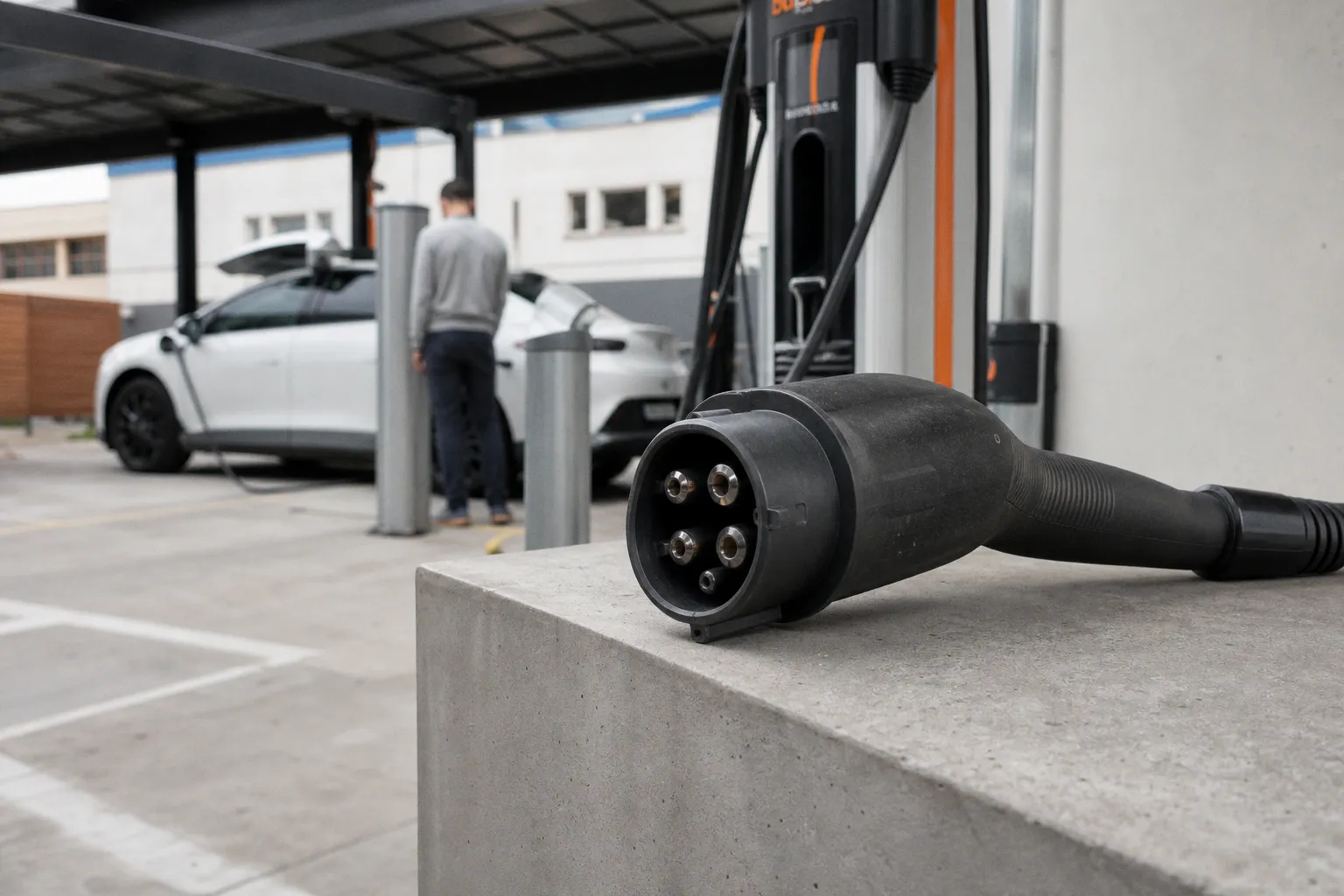
That distinction is where most bad comparisons of ChargePoint EV charging stations fail. “ChargePoint” is not a single charging speed. It is a hardware and network ecosystem that spans home AC charging, workplace Level 2, destination charging, and public DC fast charging. The useful comparison is not brand versus brand. It is AC versus DC, amps versus kilowatts, installation cost versus session cost, and connector support during the CCS1-to-NACS transition.
The Home Flex is the baseline: 240V AC, up to 50 amps
The ChargePoint Home Flex is the unit most private owners mean when they say “ChargePoint charger.” It is a Level 2 AC charger. That matters. It does not convert grid AC to battery DC inside the wall unit. The vehicle’s onboard charger does that work.
The Home Flex can deliver up to 50 amps. ChargePoint rates it at up to 37 miles of range per hour of charging. That number is useful as a shorthand, but it is not universal. A large electric SUV at highway efficiency will not gain the same real miles per hour as a compact EV driven in mild weather. Energy is the cleaner metric.
At 240V and 50A, the theoretical power is 12 kW. Real delivered power depends on circuit rating, installation configuration, vehicle onboard charger limit, and charging losses. Many EVs accept 9.6 kW or 11.5 kW on AC. Some accept less. If the vehicle’s onboard charger tops out at 7.2 kW, a 50-amp wall unit will not force it higher.
The installation flexibility is the main hardware point. Home Flex can be installed either hardwired or as a plug-in unit using NEMA 6-50 or NEMA 14-50. It is also ENERGY STAR certified. Those details are not cosmetic. They affect permitting, circuit design, portability, and how much margin the electrician has to work with.
| Parameter | ChargePoint Home Flex | Public ChargePoint DC fast charging |
|---|---|---|
| Charging type | Level 2 AC | DC fast charging |
| Typical electrical context | 240V residential circuit | Commercial high-power site |
| Maximum stated output | Up to 50A | Express Plus configurations from 62.5 kW to 500 kW |
| Conversion to battery DC | Vehicle onboard charger | Station power electronics |
| Best use case | Overnight or long-duration parking | En-route charging and short stops |
| Main bottleneck | Vehicle AC acceptance and home electrical capacity | Vehicle charge curve, site power, thermal limits, connector output |
For a home owner, the real question is not whether 50 amps sounds large. It is whether the car sits long enough to make Level 2 sufficient. For most daily use, it does. Eight hours at even a reduced Level 2 rate covers more commuting energy than most drivers consume in a day. The Home Flex is not trying to replicate a highway fast charger. It is trying to make public charging unnecessary for routine use.
A Level 2 charger wins by dwell time, not peak charge rate.
Hardwired versus plug-in is not just preference
The plug-in version has an obvious appeal. It can be removed, replaced, or relocated more easily. A NEMA 14-50 outlet is common in EV installations and has broad equipment compatibility. NEMA 6-50 is also supported. Both can be clean solutions when installed correctly.
Hardwired installation is less flexible but often cleaner electrically. It removes one connection point. It can be preferable for outdoor mounting and high-current continuous operation. Local electrical code, breaker sizing, conductor selection, and weather exposure drive the final decision.
The cost spread is not something ChargePoint can flatten into one number. Labor rates differ. Panel capacity differs. A garage with spare electrical capacity is a different job from an older service panel that needs an upgrade. The charger hardware is only one line item. The circuit can be the bigger cost.
That is why “ChargePoint station cost” is a poor single-number query. For home, the cost is hardware plus installation. For public charging, the cost is session pricing set by the site host. ChargePoint does not centrally set every public session price across its network.
Level 2 versus Level 3: the speed comparison that actually matters
The term “Level 3” is often used as a public shorthand for DC fast charging. Technically, the useful distinction is Level 2 AC versus DC fast charging. ChargePoint sells into both categories.
A ChargePoint Level 2 station supplies AC power. The car decides how much AC it can accept and converts it onboard. A DC fast charger bypasses that onboard AC charger and sends DC power to the battery pack through the vehicle’s DC charging port.
That changes the entire load path.
In Level 2 charging:
1. The station controls access, safety, metering, and current delivery.
2. AC power flows to the vehicle.
3. The onboard charger converts AC to DC.
4. The battery management system controls pack charging within its limits.
In DC fast charging:
1. The station performs high-power AC-to-DC conversion.
2. DC power is delivered directly to the vehicle battery system.
3. The vehicle communicates voltage and current limits.
4. The charge rate changes continuously as state of charge and battery temperature change.
The result is a speed gap measured in more than simple multiples. A 50-amp Level 2 Home Flex may deliver a practical overnight refill. An Express Plus DC site, depending on configuration, can deliver 62.5 kW up to 500 kW. But that upper number is site capability, not a guarantee that a given car will pull 500 kW.
No current comparison of ChargePoint EV charging stations is complete without separating station output from vehicle acceptance. A 150-kW EV plugged into a 500-kW-capable site remains a 150-kW EV, and often not for the entire session. Charge curves taper. Battery packs heat. Cold packs resist high current. High state of charge reduces acceptance. Thermal throttling is not rare; it is part of the operating envelope.
| Scenario | Limiting component | Practical result |
|---|---|---|
| Home Flex on a car with a 7.2-kW onboard charger | Vehicle onboard AC charger | The wall unit’s higher current capacity is unused |
| Home Flex on an undersized residential circuit | Electrical installation | Charger must be configured below maximum output |
| Express Plus on an EV with a low DC peak rate | Vehicle battery and DC charging hardware | Station capacity exceeds vehicle demand |
| Express Plus during high battery state of charge | Battery management system | Power tapers even if the station can provide more |
| DC fast charging in poor thermal conditions | Pack temperature and cooling system | Reduced charge rate or early taper |
This is the correct frame for a ChargePoint charging speed test. The hardware rating is only the starting condition. The session result is the intersection of station output, vehicle limit, battery state, temperature, and software negotiation.
Express Plus is public infrastructure, not a home charger with a larger cable
ChargePoint Express Plus is the company’s high-power DC fast-charging platform for public and commercial sites. The stated range is broad: 62.5 kW to 500 kW depending on configuration. That spread exists because DC fast charging is modular infrastructure. A station is not just a pedestal. It is power cabinets, dispensers, cooling, grid connection, software, payment access, and site design.
The lower end, 62.5 kW, is still materially different from Level 2 AC. It can serve urban, fleet, or dwell-time-heavy locations where vehicles stop long enough for moderate DC charging. The upper end, 500 kW, is aimed at high-throughput use cases and vehicles capable of using very high current. The name on the dispenser does not tell the whole story. The site configuration does.
At public sites, the weakest link is often not the dispenser. It can be one of five things:
- Grid capacity at the site. A high-power DC installation needs substantial electrical service. If site power is constrained, installed hardware may not operate at its theoretical ceiling.
- Power sharing across stalls. Some sites distribute available power dynamically. Two vehicles charging at once may not each receive the same rate they would see alone.
- Vehicle voltage architecture. Higher-voltage platforms can use high power with lower current for a given kilowatt figure. Lower-voltage packs may hit current limits earlier.
- Battery preconditioning. A pack that arrives too cold or too hot will not accept peak current for long.
- State of charge. Most EVs charge fastest in the lower to middle part of the battery, then taper as they approach higher states of charge.
The 500-kW figure is therefore an infrastructure capability, not a promise of a five-minute refill. It is still significant. Higher site output improves the odds that the station is not the limiting factor when a capable vehicle arrives. It also supports future vehicles with higher battery voltage, better cooling, and higher sustained charge rates.
Public DC charging is a negotiation. The dispenser offers power. The vehicle decides how much it can safely take.
The ChargePoint app is part of the product, not an accessory
ChargePoint’s hardware is tied to its software layer. The ChargePoint app manages sessions, tracks energy usage, and locates available stations across the network. For home charging, that means visibility into energy use and scheduling. For public charging, it means finding stations and starting sessions where app authentication is used.
This is not unique in the market, but it is central to how ChargePoint equipment behaves in practice. A networked charger has three jobs beyond moving electrons:
1. Access control. The charger has to know who is authorized to start a session, especially at public, workplace, or shared residential sites.
2. Energy tracking. Session history and kWh data matter for cost allocation, reimbursement, and basic usage analysis.
3. Operational status. The value of a public network depends on whether drivers can see station availability and whether the data reflects reality.
The home version benefits from the same software logic at a smaller scale. Owners can track consumption and manage charging sessions from the app. If the local utility has time-of-use rates, scheduling can matter more than peak amperage. A 50-amp charger running at the wrong time can cost more than a slower session scheduled into a cheaper electricity window.
The app does not change the physics. It cannot make a car accept more AC than its onboard charger allows. It cannot override a DC charge curve. But it can reduce wasted time and improve cost control. That is the software value: not more power, but better control over when and where power is used.
CCS1, J1772, and NACS: connector support during the transition
ChargePoint has supported major North American charging standards including J1772 and CCS1, and has begun integrating NACS connectors into its hardware lineup following the broader market shift announced in 2023. This transition is not a footnote. It affects buying decisions for both home and public infrastructure.
For Level 2 AC charging, J1772 has been the common non-Tesla connector in North America. NACS is now moving into broader adoption. For DC fast charging, CCS1 has served many non-Tesla EVs, while NACS integration is expanding as automakers migrate.
The practical issue is connector matching. The charging standard determines whether a vehicle can plug in directly, needs an adapter, or cannot use a station in a given configuration. During the transition period, mixed connector sites will matter.
| Connector | Common role | ChargePoint relevance |
|---|---|---|
| J1772 | Level 2 AC charging for many non-Tesla EVs | Used on AC hardware including home and destination charging |
| CCS1 | DC fast charging for many non-Tesla EVs | Supported across DC fast-charging equipment |
| NACS | AC and DC charging standard moving into wider North American adoption | ChargePoint has begun integrating NACS connectors into hardware |
For a home installation, connector choice should follow the vehicle parked there most often. Adapters can cover some gaps, but a permanent daily charging setup is better when it is mechanically simple. Fewer adapters means fewer connection points and less handling.
For public infrastructure, the equation is different. A site operator wants utilization across a changing vehicle fleet. That argues for connector diversity during the transition. A DC fast-charging site that cannot serve a broad mix of vehicles will strand revenue and frustrate drivers, even if the power electronics are adequate.
The NACS transition also exposes a common misunderstanding. A connector swap does not automatically increase power. NACS support can improve compatibility. It does not, by itself, turn a 62.5-kW site into a 350-kW site or make a low-acceptance vehicle charge faster. Connector standard and station power are separate variables.
Cost: home hardware and installation versus public session pricing
ChargePoint cost breaks into two unrelated categories.
At home, the buyer faces equipment cost and installation cost. The Home Flex is the hardware. The electrical work is site-specific. A clean installation near a capable panel is one cost profile. A detached garage, trenching, load management, or panel upgrade is another. Exact installation pricing is too local to quote responsibly without an electrical assessment.
In public, the driver pays session pricing set by the site host. That may be per kWh, per minute, a flat fee, idle fee, parking fee, or a combination depending on the location and local rules. ChargePoint provides the network platform and hardware, but public pricing is not centrally uniform across all stations.
This matters for comparison shopping. A driver looking at ChargePoint station cost should avoid averaging public pricing into one national number. It will be wrong at the site level. The app is the better instrument because it shows pricing where the session will actually occur.
For cost control, the hierarchy is straightforward:
1. Use home Level 2 for routine energy if available. Residential electricity is usually more predictable than public DC pricing, and the car is parked long enough to make speed irrelevant.
2. Use public Level 2 when dwell time is already planned. Workplace, hotel, airport, and garage charging can be cost-effective if the vehicle will sit for hours.
3. Use DC fast charging for time-constrained trips. It is infrastructure built for throughput, not usually the lowest-cost energy source.
4. Do not pay for peak power the vehicle cannot use. A high-power station has value when the car can accept high DC rates and arrives in the right battery temperature and state-of-charge window.
5. Watch idle rules. Networked stations can bill or restrict access after charging ends. That is not a charging-speed issue, but it affects real cost.
The economic mistake is using DC fast charging as if it were home charging. The technical mistake is buying home amperage beyond what the vehicle, panel, or daily mileage requires. Both errors come from treating all charging as the same service.
Which ChargePoint option fits which use case
The Home Flex is the correct ChargePoint product for a private driveway or garage when the goal is routine overnight charging. Its 50-amp ceiling gives useful headroom. Its plug-in and hardwired options cover the two common residential installation paths. Its app integration gives the owner session control and energy data. It is not a fast charger in the DC sense, and it should not be evaluated as one.
Public ChargePoint Level 2 stations are best understood as dwell-time infrastructure. They work when the vehicle is parked for a long period: office, hotel, municipal lot, campus, retail center, or apartment property. The power level is lower, but the utilization model is sound if parking time is long.
Express Plus DC fast-charging stations are the road-trip and fleet-throughput side of the system. Their 62.5-kW to 500-kW configuration range covers very different site designs. A driver should look at the actual station power, connector type, vehicle DC capability, and current battery conditions before expecting a specific charging time.
| Driver or site need | Better ChargePoint fit | Reason |
|---|---|---|
| Daily home charging for one EV | Home Flex | Overnight dwell time makes Level 2 sufficient |
| Apartment or workplace parking | Networked Level 2 station | Access control and energy tracking matter |
| Highway corridor charging | Express Plus DC | Short stops require high power |
| Fleet top-ups during routes | DC fast charging, site-dependent | Throughput matters more than hardware simplicity |
| Low-cost routine charging | Home Flex where installation is practical | Energy cost and scheduling are easier to manage |
| Maximum compatibility during transition | Mixed connector public deployment | CCS1 and NACS demand will overlap |
There is no single winner because the charging jobs are different. Home Flex wins on control, simplicity, and predictable daily use. Express Plus wins on power delivery when the site and vehicle can exploit it. Public Level 2 sits between them as parking-based infrastructure.
Verdict: compare ChargePoint by load case, not logo
ChargePoint’s range is coherent once the hardware is separated by electrical role. The Home Flex is a 240V Level 2 AC charger rated up to 50 amps and up to 37 miles of range per hour under ChargePoint’s stated conditions. It is the right tool for residential charging when the electrical installation supports it and the vehicle sits for hours.
Express Plus is a DC fast-charging platform for public infrastructure, with configurations from 62.5 kW to 500 kW. It is the right tool when time matters and the site has the electrical capacity to support high output. The vehicle still controls the final charge rate.
The ChargePoint ecosystem adds value through app-based session control, energy tracking, station location, and connector support across J1772, CCS1, and expanding NACS hardware. That software layer improves usability. It does not erase the underlying physics.
The practical verdict is simple. Buy or install Home Flex for routine private charging. Use ChargePoint public Level 2 when parking time is measured in hours. Use Express Plus DC when charging time is measured in minutes and the vehicle can accept the power. Anything else is a mismatch between equipment and load case.
FAQ
What is the difference between the ChargePoint Home Flex and public DC fast chargers?
Does a 50-amp home charger guarantee faster charging for every EV?
Why does the charging rate slow down at public DC fast-charging stations?
How are public charging costs determined on the ChargePoint network?
Can I use a NACS connector with my current ChargePoint station?
Related articles
 Charging & InfrastructureBuy the Safest CCS to NACS Adapters for Non-Tesla EVs
 Charging & InfrastructureCompare EV charging stations cost for garage vs driveway
 Battery & EV TechChoose the right EV battery chemistry for freezing winters
 Renault China adds software office to develop SDVs for global market