Toyota Solid-State Battery vs. Next-Gen Li-Ion Tech
Toyota Solid-State Battery vs. Next-Gen Li-Ion Tech
Toyota has tied its EV future to two product tracks: a next-generation lithium-ion lineup launching in 2026-2027, and a solid-state battery program with a 2027-2028 commercialization target. The published benchmarks for the solid-state cell are 1,000 km of WLTC cruising range and a 10-minute charge window from 10 to 80 percent state of charge. The current bZ4X — Toyota's only mass-market BEV — uses a liquid-electrolyte lithium-ion pack rated at 71.4 kWh with a WLTC range of approximately 470 km and a peak DC charge rate of 150 kW. The delta between these two systems is not incremental. The solid-state spec sheet represents a 2x jump in range and roughly a 3x reduction in charge time at the same pack size.
The engineering constraint is not whether the chemistry works in a lab cell. Multiple solid-state variants have been demonstrated since the early 2000s. The constraint is whether Toyota can scale sulfide-based solid electrolytes into a gigawatt-hour manufacturing process that maintains yield, interfacial contact, and cycle life within automotive tolerances. Every spec on the target sheet — charge time, range, energy density — flows from solving that production problem.
The Shift from Liquid Electrolytes: Understanding Solid-State Architecture
A current production lithium-ion cell contains a liquid organic electrolyte — most commonly a mixture of ethylene carbonate (EC) and dimethyl carbonate (DMC) solvents carrying lithium hexafluorophosphate (LiPF6) salt. The liquid ionically connects the cathode (typically NMC nickel-manganese-cobalt oxide) to the anode (graphite or silicon-blended graphite) through a polyolefin separator (polyethylene or polypropylene, 15-25 μm thick). The wet cell construction is mature, cheap, and well-characterized — but it has three structural weaknesses.
Flammability. The carbonate solvent flashes below 200°C and self-sustains combustion once ignited. This is the engineering reason current BEV packs require multiple thermal containment layers: cell-to-cell ceramic separators, module-level firewalls, pack-level venting, and active coolant loops. Removing the flammable component collapses most of this packaging overhead.
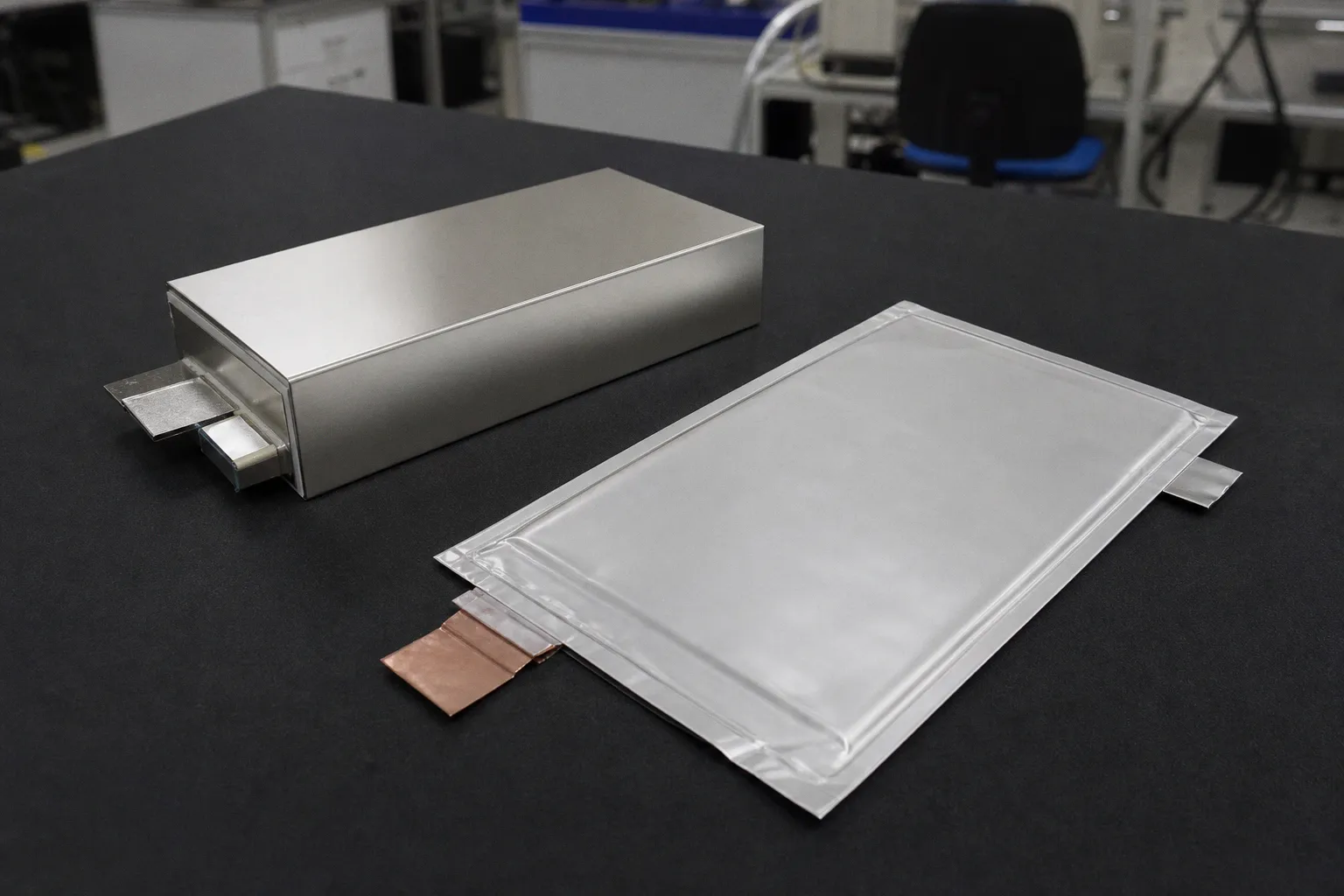
Packaging overhead. A wet cell needs sealed aluminum housing to contain the liquid. A solid cell does not. This eliminates the cell can, the cylindrical or prismatic form factor constraint, and the module-level mechanical structure. The result is a step-change in how cells stack. Solid-state enables bipolar stacking — cells layer directly in series, with the anode of one cell bonded to the cathode of the next. The volumetric energy density gain from bipolar architecture is 15-25 percent versus conventional module construction.
Toyota's solid-state research, published through partnerships with Ilika and academic collaborators, focuses on sulfide-based ceramic electrolytes — compounds in the Li10GeP2S12 (LGPS) family or argyrodite-structured Li6PS5Cl. These materials conduct lithium ions through a crystalline lattice at room temperature, with reported ionic conductivities in the 1-10 mS/cm range — comparable to liquid electrolytes at 25°C.
| Property | Liquid Li-ion (bZ4X) | Solid-State (Toyota target) | Engineering implication |
|---|---|---|---|
| Electrolyte state | Carbonate liquid with LiPF6 salt | Sulfide ceramic (LGPS / argyrodite) | Removes flammable component |
| Cell housing | Sealed aluminum can (cylindrical / prismatic) | Bipolar stack, no can | +15-25% volumetric density |
| Dendrite tolerance | Limited — separator fails at high C-rate | High — solid suppresses Li dendrite growth | Enables 4C+ continuous charging |
| Thermal conductivity (electrolyte) | ~0.2 W/m·K | ~1-5 W/m·K | Improved heat spreading at high C-rate |
| Operating temp window | 0-60°C typical, derated outside | Wider, lower thermal runaway risk | Simplifies thermal management |
The bottleneck is not solid-state chemistry. It is manufacturing yield. Sulfide electrolytes are brittle, hygroscopic, and create interfacial resistance when bonded to layered oxide cathodes.
Toyota's Dual-Track Strategy: Performance Li-Ion vs. Solid-State Innovation
Toyota is running four cell programs in parallel, not one. Three are evolution; one is a step-change.
Performance (NMC lithium-ion). The first next-gen battery scheduled for production. Toyota has stated the Performance variant delivers approximately a 20 percent range increase versus the current bZ4X pack — an additional 95-105 km of WLTC range at comparable pack capacity. The chemistry is a higher-nickel NMC811 cathode paired with a silicon-oxide-blend anode. The Performance pack is engineered for the mid-2020s EV lineup — vehicles that replace the bZ4X and an incoming three-row SUV.
Popularization (LFP). Lithium iron phosphate. Lower energy density (160-180 Wh/kg cell level vs. 250-300 Wh/kg for NMC), but lower raw material cost, longer cycle life, and reduced thermal runaway risk. This is the cell for entry-level BEVs in the 2026-2027 timeframe, including variants expected for markets like China and India where cost dominates the spec sheet.
High-Performance (advanced Li-ion). A separate chemistry track targeting roughly 30-40 percent range gain over the bZ4X, with energy density estimated at 350-400 Wh/kg at the cell level. Less publicly documented than Performance or Popularization, but acknowledged in Toyota's battery roadmap. This variant also targets the 2027-2028 window.
Solid-State. The flagship program. Operates as a separate workstream from the lithium-ion chemistry tracks. Scheduled for production in the 2027-2028 window, contingent on manufacturing qualification.
| Parameter | Performance (Li-ion) | High-Performance (Li-ion) | Popularization (LFP) | Solid-State |
|---|---|---|---|---|
| Chemistry | NMC | Advanced Li-ion | LFP | Sulfide-based solid electrolyte |
| Target range vs current bZ4X | +20% | +30-40% (est.) | Comparable to current | +100%+ (1,000 km target) |
| Target charge time (10-80%) | ~20 min | ~15 min | ~30 min | <10 min |
| Commercialization | 2026-2027 | 2027-2028 | 2026-2027 | 2027-2028 |
| Thermal stability | Standard Li-ion | Improved | Standard LFP | Non-flammable electrolyte |
| Estimated energy density (cell) | 280-320 Wh/kg | 350-400 Wh/kg | 160-180 Wh/kg | 400-500 Wh/kg |
The dual-track strategy is rational. Toyota cannot afford to wait for solid-state to ship competitive EVs. The Performance and Popularization cells provide interim products that close the range and cost gap to current Tesla, Hyundai, and BYD offerings. Solid-state is reserved for the launch cycle where it can be marketed as a differentiator rather than absorbed into the baseline specs.
Performance Targets: Decoding the 1,000 km Range and 10-Minute Charge
The two flagship numbers on Toyota's solid-state slide — 1,000 km range, 10-minute 10-80 percent charge — require translation.
The 1,000 km range figure. This is WLTC. On the more stringent EPA cycle, the same pack delivers 700-800 km of usable range. Either number is a meaningful jump from the bZ4X's current 470 km WLTC / ~320 km EPA. The implied pack capacity, back-calculated from a 400 Wh/kg cell-level energy density and 70-75 percent pack-level efficiency factor, is approximately 75-95 kWh — broadly equivalent to current BEV pack sizes. The range gain comes from chemistry efficiency, not from a larger pack.
The 10-minute charge figure. Current 800V platforms achieve 10-80 percent SOC in approximately 18-22 minutes at peak DC rates of 250-350 kW. Toyota's stated target is roughly half that time, implying sustained C-rates of 4C-6C throughout the charging window. For a 90 kWh equivalent pack, that requires sustained pack-level power of 350-540 kW. Current production chargers peak at 350 kW but typically taper fast above 50-60 percent SOC due to cell-level thermal limits. Toyota's target implies the cell sustains high C-rates up to 80 percent SOC without thermal throttling.
Three engineering requirements drive the 10-minute target.
1,000V system architecture. Higher voltage reduces current draw at any given power level. A 350 kW charge at 800V is 438A. At 1,000V, the same power is 350A — a 20 percent reduction in cable current and associated thermal losses. Toyota's planned BEV platform, distinct from the bZ4X's 400V architecture, is engineered for 1,000V operation.
Cell-level thermal pathways. Heat generated inside the cell during fast charging must travel through the electrolyte to the cooling plate. Sulfide ceramic electrolytes have 5-25x higher thermal conductivity than carbonate solvents (~0.2 W/m·K). This reduces thermal gradient between the cell core and the cooling interface, enabling faster heat extraction at high current.
Anode plating resistance. Fast charging creates lithium plating risk — lithium ions deposit on the anode surface as metallic lithium instead of intercalating into the graphite structure. Plating is irreversible, reduces capacity, and accelerates capacity fade. Solid electrolytes physically suppress dendrite and lithium whisker formation at high C-rates. This is the primary chemistry-level mechanism that unlocks the 10-minute target.
Commercialization Timeline: Navigating the 2027-2028 Production Window
Toyota announced the 2027-2028 window at technical briefings in 2023 and reiterated it at subsequent automotive forums. The schedule is contingent on three unconfirmed production milestones.
Material handling and dry room specs. Sulfide electrolytes react with atmospheric moisture, releasing hydrogen sulfide (H2S) — a toxic gas at low concentrations. Production facilities require dry rooms at dew points below -40°C, with H2S scrubbing on the exhaust stream. Standard lithium-ion dry rooms operate at -20°C to -30°C dew point. The capital expenditure differential for the solid-state line is meaningfully higher per kWh of installed capacity than NMC lines, though Toyota has not published specifics.
Stack pressure during cell operation. Solid-state cells require sustained mechanical pressure (5-50 MPa, depending on cell architecture) to maintain interfacial contact between the solid electrolyte and the cathode active material. Without this pressure, contact area degrades over cycles, increasing internal resistance and reducing usable capacity. Automotive modules must integrate mechanical pre-load into the pack structure — either through rigid cell holders or through compression frames. This is a packaging requirement with no analog in liquid-electrolyte modules.
Cycle life at automotive depth of discharge. Industry standard for automotive lithium-ion is 1,500-2,000 full equivalent cycles at 80-90 percent depth of discharge to reach 70-80 percent of initial capacity — the warranty threshold. Toyota needs solid-state to hit similar numbers. Lab data exists; long-term automotive-scale data does not. Production warranty terms for the 2027-2028 launch will be a leading indicator of whether this milestone was met.
The 2027-2028 window is Toyota's stated timeline, not industry-consensus market reality. Historical slippage on new automotive cell chemistries averages 12-24 months from announced launch to volume production. The schedule should be treated as optimistic.
Safety and Energy Density: Why Solid-State Remains the Industry Holy Grail
The argument for solid-state is twofold: a safety floor and an energy density ceiling.
On safety, current lithium-ion packs operate within a tightly engineered thermal envelope. The pack's job is to keep every cell below approximately 60°C during operation and to contain any cell that enters thermal runaway. If a single cell vents, the pack design must prevent propagation to neighboring cells within a defined window — typically 5-10 minutes, the time required for occupants to exit. This is the regulatory and engineering constraint behind the heavy packaging in current BEVs.
A solid-state cell with a non-flammable electrolyte changes the math. There is no combustible liquid to ignite during a thermal event. The decomposition temperature of the solid electrolyte is higher, and the failure mode is more localized. Pack designers can drop multiple safety subsystems — module-level firewalls, certain venting requirements, some coolant redundancy — without compromising occupant safety. The result is lower packaging overhead and higher pack-level energy density for a given cell-level chemistry.
The cell ceiling on current NMC chemistry is roughly 300 Wh/kg. Solid-state unlocks a 400-500 Wh/kg ceiling, but only if paired with a lithium-metal anode. Toyota has not disclosed the anode chemistry for the production cell.
On energy density, the theoretical ceiling for a lithium-metal solid-state cell is 400-500 Wh/kg at the cell level. Real production cells sit lower, but the direction is clear. For comparison, the bZ4X pack operates at approximately 175-185 Wh/kg pack-level / 250-260 Wh/kg cell-level. A solid-state pack at 350-450 Wh/kg cell-level and 250-300 Wh/kg pack-level is a 50-70 percent jump in usable energy for the same pack weight.
The trade-off is cycle life. Lithium-metal anodes expand and contract on cycling, creating mechanical stress at the interface with the solid electrolyte. This is the cycle-life issue that has dogged solid-state development since the early 2000s. The two production paths are a silicon-blended anode (better cycle life, lower energy density) or a pure lithium-metal anode (higher energy density, harder cycle life target). Toyota has not disclosed which path the production cell takes.
Cost is the third unknown variable. Cell-level cost per kWh is not published. Solid-state raw materials per kg are cheaper than NMC, but processing costs are higher and production volumes are lower. The crossover point — when solid-state $/kWh drops below liquid Li-ion $/kWh — depends on yield rates and the ramp curve. No external industry analyst has published a credible per-kWh projection at this stage.
Verdict
Toyota's solid-state roadmap targets credible engineering benchmarks: 1,000 km WLTC range, 10-minute 10-80 percent charging, and 400+ Wh/kg cell-level energy density. The 2027-2028 timeline is a Toyota-stated production estimate, not a confirmed market launch. Realistic volume production sits in the 2028-2030 window, with initial capacity likely allocated to flagship models rather than mass-market vehicles.
The interim products matter more than the solid-state announcement. Toyota's Performance (NMC) cell, slated for 2026-2027, delivers an immediate 20 percent range gain over the bZ4X at competitive cost. Popularization (LFP) opens the entry-level BEV segment in markets where cost dominates the spec. Those two products — not solid-state — are what Toyota needs to ship to be competitive in 2026-2027.
Solid-state is the long bet. Watch for sulfide electrolyte yield rates, 1,000V platform deployment, and cycle life data as the production launch approaches. Those three data points, not the marketing slides, will determine whether Toyota hits the 2027-2028 window or slips to the back half of the decade.