Home EV charger installation: hardwired or plug-in?
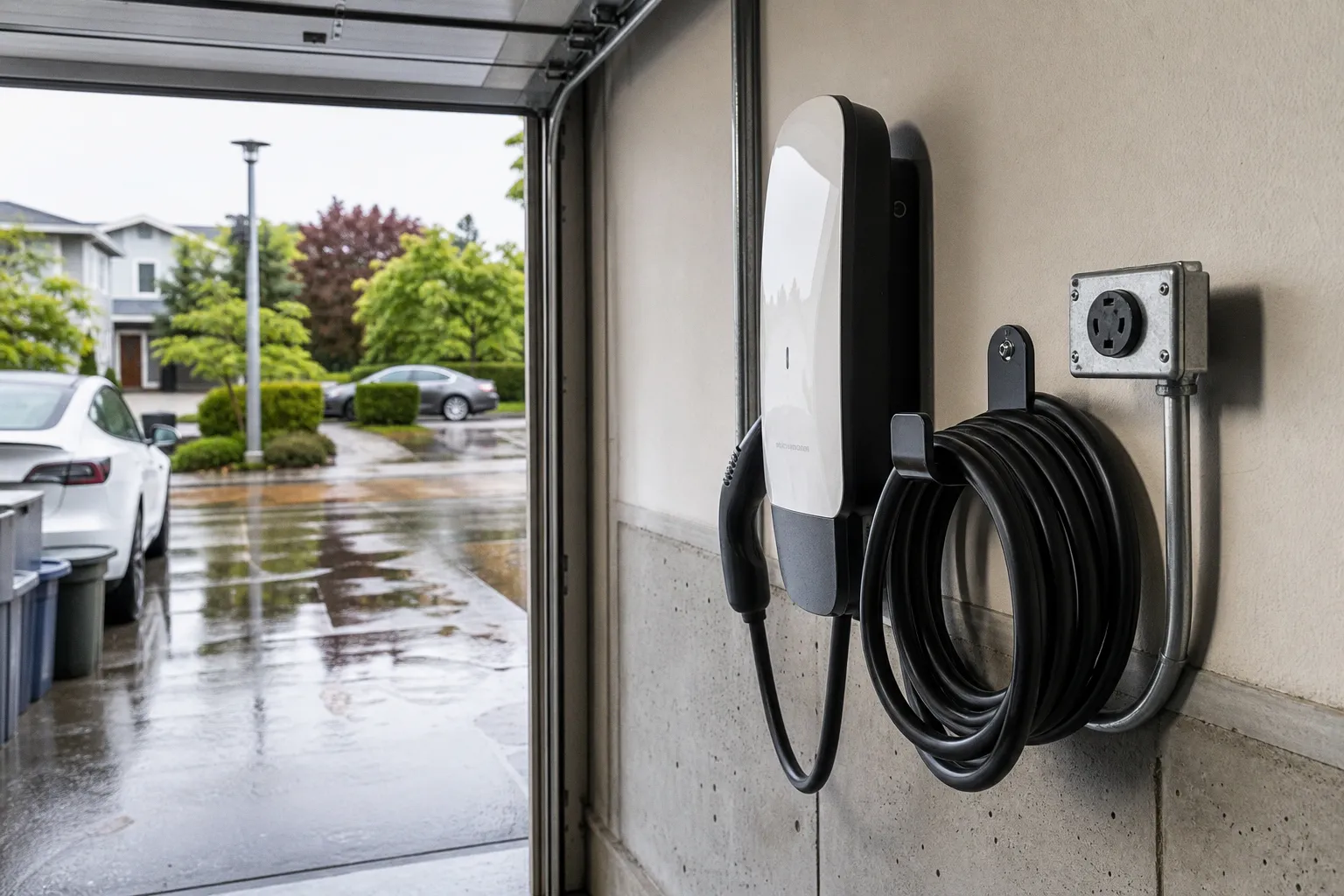
I have seen the aftermath: browned plastic around the receptacle face, heat-stiffened wire insulation, and an owner wondering why a “simple outlet install” has turned into a service call. The car was fine. The charging cable was fine. The cheap receptacle, asked to deliver near its limit for hours every night, was not.
That is the unglamorous fork in the road for a home EV charger installation: plug-in convenience or hardwired permanence. A plug-in Level 2 charger can be entirely code-compliant and genuinely useful. But it is no longer the automatic budget choice many installers and sales pages make it out to be. Recent electrical-code requirements have added GFCI complications, while a hardwired unit removes the outlet from the equation and usually unlocks more power.
For most owners installing a dedicated charger at home, I would hardwire it. Not because a plug-in charger is forbidden—it is not—but because the wall outlet is one more connection that can heat up, loosen, trip, or generally decide to become a problem when you are already late for work.
The NEC shift made the plug-in route less simple
The popular plug-in setup is straightforward on paper: install a 240-volt NEMA 14-50 receptacle, hang a charger nearby, plug it in, and charge at up to 40 amps. For years, that was the default answer to nearly every “What charger should I buy?” question.
Then the electrical code caught up with the fact that EVs do not use a 14-50 outlet like an occasional RV or a kitchen range. An EV can pull near its maximum allowed load for five, eight, or twelve hours without blinking. That is a continuous load, and continuous loads are where casual electrical decisions get expensive.
Under the National Electrical Code’s 80% continuous-load rule, a charger plugged into a 50-amp circuit is limited to a 40-amp continuous draw. That works out to roughly 9.6 kW at 240 volts. It is still plenty for many drivers. But the code picture changed in the 2020 NEC and remained in the 2023 edition: receptacles installed for EV charging require GFCI protection.
A standard Class A GFCI breaker trips at roughly 4–6 mA of ground-fault current. EV charging equipment has its own ground-fault monitoring, typically a CCID20 system that trips around 20 mA. Two safety systems watching the same circuit can occasionally get twitchy together. The result is nuisance tripping: the charger stops in the middle of the night, the car quietly fails to refill, and the first indication is a low-battery warning when you need to leave.
That does not mean every plug-in charger will have a GFCI problem. Many operate without drama. It means the installation has more moving parts, and the electrician cannot simply bolt in a receptacle, toss a bargain breaker into the panel, and call it a day.
A home charger is not an appliance you use for 20 minutes. It is a high-load electrical connection that may run unattended longer than you sleep.
Hardwired equipment generally avoids the plug-and-receptacle rule because there is no receptacle. The EVSE is connected directly to the branch circuit and normally carries its own personnel-protection system. But “generally” is doing real work here. Local code adoption matters, and outdoor installations can trigger additional GFCI requirements. NEC 210.8(F), for example, covers certain outdoor equipment on 50-amp-or-smaller branch circuits in jurisdictions enforcing the relevant code edition.
Your local inspector and licensed electrician get the final say. The useful takeaway is simpler: hardwiring often reduces the GFCI conflict risk, but it does not put an installation outside the reach of local electrical rules.
The 40A versus 48A gap is real—until your car closes it
The speed argument is often presented like a drag race. Plug-in: slow. Hardwired: fast. That is too tidy.
A 40-amp plug-in EV charger on a 50-amp circuit can deliver up to 9.6 kW. A hardwired charger on a properly sized 60-amp circuit commonly delivers 48 amps, or about 11.5 kW. That is a 20% jump in available charging power. In a home that needs to turn around two EVs overnight, or where a driver arrives nearly empty after a long highway day, the difference is not decorative.
But the vehicle’s onboard charger has veto power. If your EV accepts only 32 amps on AC, it will take roughly 7.2 kW whether the wall unit is a 40-amp plug-in model or a 48-amp hardwired model. The extra capacity sits there looking impressive and accomplishing nothing.
This is the comparison that actually matters during a home EV charging setup:
| Parameter | Plug-in Level 2 charger | Hardwired Level 2 charger |
|---|---|---|
| Typical circuit | 50A | 60A for a 48A unit |
| Maximum continuous output | 40A / about 9.6 kW | 48A / about 11.5 kW |
| Main physical failure point | Receptacle and plug contacts | Terminations inside charger and panel |
| GFCI complication | Receptacle generally requires GFCI protection under 2020/2023 NEC | Depends on location and local code; no plug/receptacle requirement |
| Portability | Can be unplugged and moved | Fixed installation |
| Best fit | Modest daily driving, renters with permission, specific portability needs | Most permanent homeowner installations |
Before paying for a larger circuit, check three numbers:
1. Your EV’s maximum AC charging rate. This is commonly listed in amps or kW in the owner’s manual. A 32-amp vehicle does not become a 48-amp vehicle because the wallbox has a bigger number on the box.
2. Your panel’s available capacity. A 60-amp charger circuit is not a casual add-on in a crowded 100-amp service panel. Load calculations are not paperwork theater; they determine whether the house can carry the load without a costly service upgrade.
3. Your actual overnight window. A car parked for ten hours does not need the same charging power as a car that arrives at 8 p.m. and must leave again at 5 a.m. Plenty of households will never notice the difference between 40 and 48 amps.
The hardwired advantage is not that everyone needs 11.5 kW every night. It is that a new dedicated circuit is infrastructure expected to outlive the current car. Building it with a little headroom is usually sensible if the panel and budget allow it.
The outlet is where “good enough” starts cooking
A NEMA 14-50 is a connector standard, not a quality guarantee. That distinction gets buried beneath a mountain of cheerful charger reviews.
Many residential-grade 14-50 receptacles were designed around intermittent use: a range, a welder, perhaps an RV connection that is not running flat-out every night of the week. EV charging is different. The sustained load exposes weak contacts, poor torque on terminals, cheap internal construction, and plugs that were never fully seated. Heat builds at resistance points. Resistance rises as the connection deteriorates. Then the outlet begins its slow march toward failure.
The severe cases are easy to spot: melted faceplate, discolored plastic, a plug that feels welded in place. The early warnings are quieter:
- The plug or receptacle feels noticeably warm after a long charge. “Warm” is not a number, but it should prompt inspection rather than denial.
- The charging session stops intermittently without an obvious vehicle error.
- The plug fits loosely or the receptacle has visible discoloration.
- The charger is set to pull 40 amps from a generic, residential-grade outlet installed years ago for another appliance.
- The outlet is outdoors or in a damp garage, where weather, corrosion, and mechanical wear add their own little votes against reliability.
If you go plug-in, use an industrial-grade receptacle appropriate for continuous EV duty, have it installed on a dedicated circuit, and make sure the electrician knows it will serve an EVSE—not a dryer, not a theoretical future RV. That last detail changes the design conversation.
Hardwiring eliminates the outlet and plug contacts, which removes a major heat-failure point. It does not remove the need for competent work. A loose conductor termination in the charger or panel is still a loose conductor termination. But there are fewer joints in the chain, fewer things to wiggle loose, and fewer chances for a $20 component to ruin a charging system worth several thousand dollars.
I prefer fewer failure points. Public fast-charging networks taught me that lesson the hard way. A bricked dispenser can at least be driven away from. A bricked home charging connection has nowhere to hide.
Flexibility is useful, but it is not free
The best case for a plug-in charger is legitimate: you want to take it with you.
Maybe you are renting and have permission for a 14-50 installation but do not want to leave a $600 or $800 EVSE behind. Maybe you move frequently. Maybe you visit an RV park, a cabin, or a family property with a suitable receptacle and want the option to bring your equipment. A plug-in unit gives you that mobility.
It also makes replacement painless. If the EVSE itself fails, you unplug it and swap in another compatible unit. With a hardwired unit, replacement is still routine for an electrician, but it is not a two-minute homeowner job.
That flexibility comes with a catch: portability encourages people to treat a high-power charger like a travel accessory. Repeated plugging and unplugging adds wear. So does running the unit from unknown outlets at destinations where you have no idea what is behind the wall, who installed it, or whether the receptacle has spent a decade baking in summer heat.
For an owner who genuinely uses the charger away from home, plug-in makes sense. For an owner who will plug it in once and never touch it again, “portable” is mostly an expensive word for “another connection to maintain.”
If the charger will live on one wall for the next five years, hardwiring is usually not a sacrifice of flexibility. It is an admission of reality.
The install quote can lie by omission
Comparing level 2 charger install cost requires more than looking at the number at the bottom of an electrician’s estimate. A plug-in quote can look cheaper because the equipment is lower-power or because it assumes a basic receptacle installation. Then the modern code requirements arrive, along with a GFCI breaker and a higher-quality outlet, and the gap narrows fast.
A hardwired 48-amp installation generally needs a 60-amp circuit, which can mean heavier conductors, a larger breaker, and more panel capacity than a 50-amp plug-in setup. If the run from panel to garage is long, material cost rises. If the service panel is full or undersized, either path can get ugly.
The quote needs to answer the boring questions—the ones that decide whether a charger behaves properly after the installer’s truck is gone:
- Is the circuit dedicated exclusively to EV charging?
- What amperage is the charger being configured to draw, and does that match the conductor and breaker sizing?
- For plug-in installations, is the receptacle rated and selected for sustained EV charging rather than generic appliance duty?
- Does the jurisdiction require a GFCI breaker for the particular location and code edition?
- Is the unit indoors, outdoors, or exposed to weather?
- Is the electrical service capable of the new continuous load, or will load management or a service upgrade be needed?
- Can the charger be set to a lower current if the panel calculation demands it?
Smart load management deserves more attention than it gets. If a household cannot comfortably add a full 60-amp circuit, a managed charger that reduces or pauses charging when the house load spikes can be a cleaner answer than immediately rebuilding the service entrance. It is not magic; it is an engineered compromise. But it can turn “service upgrade first” into “charge overnight without tripping the main breaker.”
The cheapest installation is often the one that looks cheapest only until the first nuisance trip, overheated receptacle, or panel upgrade. That is not anti-plug-in rhetoric. It is simply the cost of running high current for long periods in a real house rather than on a product-spec sheet.
My verdict: hardwire the charger, unless you have a reason not to
For a permanent homeowner installation, hardwired is the better default. It can support 48 amps on a 60-amp circuit, removes the receptacle as a high-load failure point, and usually avoids the awkward dance between an EVSE’s internal protection and an external GFCI breaker required for a receptacle circuit.
The caveat is not trivial: confirm your car can accept more than 40 amps, your panel can support the circuit, and your local code requirements are satisfied—especially outdoors. There is no prize for installing a 48-amp unit that your EV can only feed from at 32 amps.
Choose plug-in when portability is a real requirement, not an imaginary future scenario. If you do, spend properly on the receptacle, the dedicated circuit, and the GFCI-compliant installation. Do not build a 40-amp nightly ritual around the cheapest 14-50 outlet on the supply-house shelf and call it savings.
Home charging should be the dullest part of EV ownership: park, plug in, wake up full. Hardwiring is not glamorous. That is precisely why it wins.
FAQ
Should I choose a hardwired or plug-in EV charger for my home?
Why do plug-in EV chargers sometimes stop charging in the middle of the night?
Does a hardwired charger always charge faster than a plug-in model?
What should I look for if I decide to install a plug-in EV charger?
How can I tell if my home electrical panel can handle an EV charger?
Related articles
 Charging & InfrastructureBuy the Safest CCS to NACS Adapters for Non-Tesla EVs
 Charging & InfrastructureCompare EV charging stations cost for garage vs driveway
 Charging & InfrastructureChargePoint EV charging stations compared by speed and cost
 Thailand locks in $4.1 billion in EV supply chain investment as auto sector pivots